

When nonprofit employees split their time between programs, administration, and fundraising, determining where their expenses belong can get complicated fast. The same challenge applies to shared office space, technology, and other operating costs.
How your nonprofit organization allocates these expenses affects its financial statements, program expense ratio, and the financial information available to leadership, donors, and other stakeholders. So how do you determine which expenses belong where? And how can you make sure your allocation methods are accurate, consistent, and defensible?
Let’s look at some practical approaches to functional expense allocation and the documentation that supports them.
What is functional expense allocation?
Functional expense allocation is the process of assigning a nonprofit’s expenses to program services, management and general activities, or fundraising based on how resources are used. When expenses support multiple functions, organizations must use reasonable, documented methods to divide those costs accurately.
Under US GAAP, non-profits must include a statement analyzing expenses by both their natural and functional categories.
What exactly does that mean? A natural category describes what the organization purchased. For example, the purchase of copy paper for the office would be categorized as “office supplies” whereas the payment to a contractor to lead an educational event your organization is hosting would be categorized as “professional services.” Office supplies and professional services would be the natural categories. Using the same two examples and looking at the functional categories for each, the buckets change. Functional categories speak to how the money spent was used instead of what the money was spent on.
The three functional expense categories:
Program Services
Costs directly related to carrying out the organization's mission and delivering services.
Management & General
Administrative expenses necessary to operate the organization, including governance, finance, human resources, and executive management.
Fundraising
Costs associated with soliciting donations, managing donor relationships, grant development, and fundraising events.
Office supplies are generally classified as management expenses whereas professional services would be classified as a program expense (assuming that the event serves your mission). A simplistic example of a Statement of Functional Expenses showing both the natural and functional categories is below.
Why does functional expense allocation matter?
For nonprofit organizations, every dollar tells a story. Donors want to know how their contributions create impact, grant makers expect financial transparency, and regulators require organizations to accurately report how expenses support their mission. That’s why we care so much about functional expense allocation.
Properly allocating expenses across programs, management and general activities, and fundraising isn’t just an accounting requirement—it’s a best practice that strengthens financial reporting, supports informed decision-making, and builds trust with stakeholders.
Program expense ratios
Nonprofit organizations are evaluated on a variety of metrics, and one of those metrics is their program efficacy/program expense ratio. That metric tells an interested party how much of every dollar raised is spent on programmatic activities. To calculate this metric, you simply take the total program expenses and divide by the total expenses.
While no single program expense ratio is appropriate for every nonprofit, I generally encourage organizations to aim for 75% or more of their expenses to support program activities. In my experience, this provides a useful benchmark for evaluating how resources are distributed, although the organization’s mission, operating model, and stage of development should also be considered.
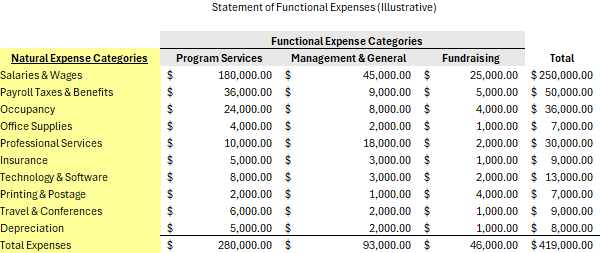
Using the above example the rate would be 66.8% ($280,000 of program expenses / $419,000 total expenses). At 66.8%, this organization’s program expense ratio falls below the 75% benchmark I typically recommend. I would encourage leadership to evaluate what’s driving that percentage, whether there are opportunities to direct more resources toward programs, and how to communicate the value of necessary administrative and fundraising investments. Any changes to expense allocations, however, must reflect how resources are actually used.
Program Expense Ratio | Interpretation |
|---|---|
85% or higher | Excellent A high percentage of expenses support mission related programs |
75-85% | Strong Typical for many well-managed nonprofits |
65-75% | Acceptable May be appropriate for organizations investing in growth, infrastructure, or fundraising |
Below 65% | Worth Evaluating Not Necessarily problematic, but stakeholders may expect an explanation |
Having a strong to excellent ratio demonstrates accountability to donors and grant makers, can improve budgeting and financial planning, and provides leadership with better insight into the true cost of delivering programs.
Related Resource: Improving Your Charity Navigator Rating
How to allocate nonprofit expenses
One of the most common challenges I see nonprofit management teams face is deciding how to classify expenses that support multiple activities. The examples I gave above are pretty straightforward. But what if an organization uses something it purchased across multiple categories? What if they are evaluating wages and benefits for employees or rent for the entire office? For situations like this I recommend an allocation. The methodology for that allocation should always reflect how resources are actually used rather than aiming to achieve a particular program expense ratio.
Salaries and benefits based on employee time
One of the most common allocation bases is personnel time, especially as employee compensation often represents one of the largest nonprofit expense lines. As such, allocating these costs can have a material impact on an organization’s program expense ratio. When evaluating how to allocate an employee’s costs over the 3 functional areas I recommend completing periodic time studies or maintaining detailed time records showing how each employee spends their work hours.
Program Director
- 75% Program
- 25% Management
Executive Director
- 50% Program
- 30% Management
- 20% Fundraising
Once this allocation is determined and documented. I recommend that payroll taxes and employee benefits follow the same allocation percentages as salaries.
Occupancy costs based on square footage
Another popular allocation method is based on square footage of the space being used. For example, if program staff occupy 65% of office space, management occupies 20%, and development occupies 15%, occupancy costs could be allocated using those percentages.
Occupancy costs would include
- Rent
- Utilities
- Building insurance
- Maintenance
- Depreciation
Shared expenses based on usage
Finally, consideration should be given to shared costs. Often technology expenses fall into this category.
Examples
- Internet
- Software subscriptions
- Office supplies
- Telephone services
These costs are generally utilized by multiple areas that don’t necessarily align with either the personnel allocation or square footage allocations described earlier.
Allocations of these types of costs can be driven by
- Employee headcount
- User licenses
- Device assignments
- Time usage when practical
How to document your expense allocation methods
Once your organization has settled on which allocations are appropriate for the various expenses, a written allocation policy should be created. This creates clarity, and demonstrates that the allocations are reasonable, systematic, and consistently applied.
When writing the policy it should describe:
- Which expenses are allocated.
- Allocation methods used for each expense category.
- How allocation percentages are calculated.
- How often percentages are reviewed.
- Who approves changes to the methodology.
One important point noted above is the determination of how often these allocations are reviewed. Organizations evolve throughout the year. New programs, staffing changes, office moves, or major fundraising initiatives may significantly change how resources are used. I recommend reviewing allocation percentages at least annually – ideally during the budget season, or whenever major operational changes occur.
Are your expense allocations still accurate?
If your nonprofit has added programs, changed staffing responsibilities, or expanded its operations, your existing expense allocation methods may no longer reflect how resources are used. Reviewing your allocation policy and supporting documentation can help you identify outdated assumptions before they affect your financial reporting.
If you have questions about your organization’s functional expense reporting or allocation methods, the Wegner CPAs Accounting Solutions Group can help you evaluate your approach.