




Finishing your association’s audit does not automatically prepare your board to discuss the results.
Board members may receive dozens of pages of financial statements, auditor communications, schedules, and technical notes. Yet during the meeting, they usually need clear answers to a much shorter list of questions:
- What did the auditors conclude?
- What changed financially this year?
- Are there risks or control matters requiring attention?
- What decisions or follow-up actions are needed?
A board-ready audit packet turns the audit documentation into a focused governance resource.
It helps board members understand the financial story, ask informed questions, and act on significant findings without requiring them to interpret every accounting detail independently.
This guide explains what to include, how to present it, and how to make the packet useful before, during, and after the board meeting.
Begin With the Decisions the Board Must Make
Management and the board experience the audit differently.
The finance team may spend months preparing schedules, answering auditor questions, and reviewing detailed information. Whereas most board members enter the process at a higher level. They want to know whether the financial statements are reliable and whether anything requires their oversight.
Before assembling documents, identify what the board needs to understand or decide.
A useful board audit packet should answer:
- What opinion did the auditors issue?
- How did actual results compare with the budget and prior year?
- Which changes in revenue, expenses, cash, or reserves matter most?
- Were audit adjustments proposed?
- Did the auditors identify internal control matters?
- What actions should management or the board take next?
The complete audited financial statements, as well as applicable letters from the auditors, should still be included. The purpose of the supporting materials is to direct attention to the information that matters most.
Put a Concise Executive Summary First
The executive summary is often the most important part of the packet. It should tell board members what happened, why it matters, and what requires attention. Many associations can accomplish this in one page, although a complex audit may require two.
Include three core sections:
1. Audit Conclusion
State that the audit is complete, identify the opinion issued, and explain the result in plain language.
For example: The auditors completed the audit of the association’s financial statements for the year ended December 31. They issued an unmodified opinion. In plain language, the auditor concluded that the financial statements are presented fairly, in all material respects, in accordance with the applicable accounting framework.
An unmodified opinion is the standard favorable result. It is not a guarantee that every transaction was correct or that the organization faces no financial, operational, or compliance risks. An audit is designed to provide reasonable assurance on the financial statements based on the procedures performed.
2. Significant Financial Developments
Summarize the developments that had the greatest effect on the year.
Depending on the association, these may include:
- Membership or dues changes
- Conference performance
- Staffing or vendor costs
- Reserve activity
- Investment results
- Technology implementation costs
- New programs or affiliated entities (e.g. related 501(c)3 foundations)
Focus on developments that help the board understand the association’s direction. Do not repeat every line of the financial statements.
3. Matters Requiring Attention
Identify open decisions, recommendations, risks, or monitoring responsibilities.
For each item, clarify:
- What the issue or recommendation is
- Why it matters
- Who is responsible
- When the next action will occur
- Whether board approval or oversight is needed
This section gives the meeting a clear agenda and reduces the risk that an important follow-up item gets lost in the supporting documents.
Add Financial Schedules That Explain the Story
Audited financial statements provide essential information, but they do not always answer the board’s operational questions.
Add a small number of schedules that connect financial results to the budget, prior-year performance, reserves, membership, and major programs. This can vary from association to association depending on the nature of the items needing to be highlighted.
Budget-to-Actual Results
Show actual results next to the board-approved budget. Highlight significant variances and explain their causes.
Avoid explanations that simply repeat the number.
Instead of, “Conference expenses were over budget.” Use an explanation that provides context.
Example 1
Conference expenses exceeded budget by $85,000 because attendance was higher than projected and the association added meeting space and audiovisual services. Higher registration and sponsorship revenue offset part of the additional cost.
A useful variance explanation tells the board:
- What changed
- Why it changed
- Whether it was expected
- How management responded
- What management expects next
Example 2
Membership dues revenue finished 6% below budget. Renewal rates remained stable, but new member acquisition was lower than projected during the first half of the year. Management adjusted outreach activities in the third quarter and updated the membership assumptions used in next year’s budget.
That explanation gives the board context and demonstrates that management is responding.
Current-Year and Prior-Year Comparison
A year-over-year comparison helps the board identify trends that may not be visible in a single period. Depending on membership trends, a historical lookback of three years or more may also be useful to the board.
Focus on meaningful changes in areas such as:
- Membership and dues revenue
- Conference revenue and direct costs
- Staffing and professional services
- Technology expenses
- Cash and liquidity
- Net assets and reserves
Board members rarely need commentary on every account. Instead, direct their attention to changes that affect financial sustainability or strategic decisions.
Related Content: Read Inflation, Rising Costs, and the Association Audit
Reserve and Liquidity Overview
Include a schedule showing how reserves changed during the year and whether they remain aligned with board policy.
The schedule may include:
- Beginning reserve balance
- Contributions and withdrawals
- Investment gains or losses
- Ending reserve balance
- Reserve-policy target
- Planned uses of reserve funds
Explain why reserves were used or increased and how the decision supports the association’s operating or strategic priorities.
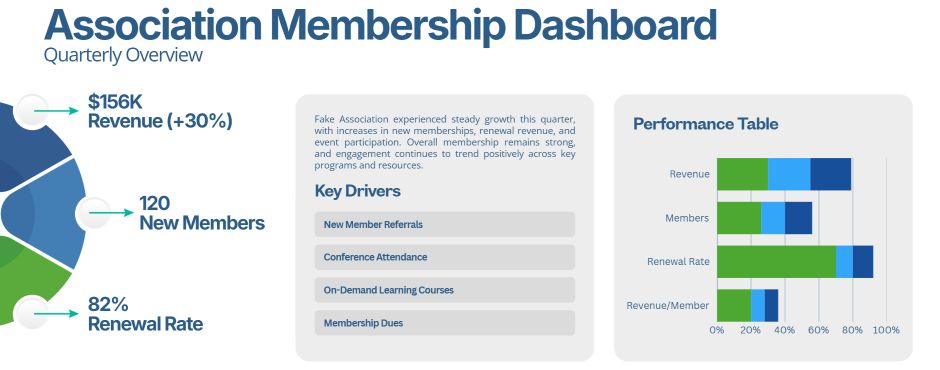
Membership or Conference Dashboard
An operational dashboard can help the board understand what drove the financial results
A membership dashboard might include:
- Total members
- Renewal rate
- New members
- Average dues revenue
- Revenue per member
A conference dashboard might include:
- Registrations
- Sponsorship and exhibit revenue
- Net contribution
- Comparison with budget and prior year
Choose measures that help explain the numbers. Avoid adding metrics simply because they are available.
Translate Audit Terms Into Plain Language
Board members should not need an accounting background to participate in the discussion. Include a brief glossary or callout box for terms that appear in the audit documents.
The audit opinion communicates the auditor’s conclusion about whether the financial statements are presented fairly under the applicable accounting framework.
An unmodified opinion is the standard favorable result. It does not mean the auditor reviewed every transaction or that the association faces no financial or operational risk.
An audit adjustment is a change identified during the audit process.
Some adjustments result from information received after the accounting records were initially closed. Others may reveal an opportunity to improve reconciliations, reviews, estimates, or year-end procedures.
Explain whether each adjustment was isolated or connected to a recurring process issue.
Auditors may communicate significant deficiencies, material weaknesses, or other control and process recommendations.
Not every recommendation is a formal control deficiency. The packet should use the auditor’s terminology and clearly distinguish formal findings from advisory or process-improvement comments.
Avoid minimizing a finding. At the same time, do not imply that every recommendation means misconduct occurred or that the financial statements are unreliable.
For each matter, explain what occurred, the risk involved, management’s response, and the expected completion date.
Under U.S. GAAP, management evaluates whether conditions and events raise substantial doubt about the organization’s ability to meet its obligations within one year after the financial statements are issued, or available to be issued when applicable.
When this issue arises, explain the underlying conditions, management’s evaluation, and the plans intended to address them. Coordinate the presentation with the audit team so the board receives information consistent with the financial statement disclosures and auditor’s report.
Present Control Matters With Accountability
Control recommendations can create unnecessary confusion when they are presented without context.
For each recommendation or deficiency, include:
- A plain language description
- The risk the control is intended to address
- Management's corrective action
- The responsible owner
- The expected completion date
- The method for reporting progress
Example:
The auditors recommended documenting a secondary review of monthly bank reconciliations. Management has been performing an informal review, but the review was not consistently recorded. Beginning in August, the controller will sign and date each reconciliation after completing the review.
This explanation helps the board distinguish among a documentation issue, a process weakness, and a more serious risk.
Include unresolved matters in an action tracker so the finance or audit committee can monitor progress between meetings.
Arrange the Packet in Meeting Order
The organization of the packet should match the sequence of the board discussion.
A practical board audit packet may include:
- Cover page and meeting date
- Executive summary
- Audit opinion overview
- Financial highlights
- Budget-to-actual comparison
- Prior-year comparison
- Reserve and liquidity schedule
- Membership or conference dashboard
- Summary of audit adjustments
- Internal-control matters
- Management responses
- Required auditor communications
- Proposed motions, acknowledgments, or approvals, as applicable
- Complete audited financial statements
- Follow-up action tracker
The exact contents will depend on the association’s size, governance structure, and audit results.
Send the packet early enough for meaningful review. In the cover email, identify the sections that deserve special attention and explain how board members can submit questions before the meeting.
During the presentation, follow the same order as the packet. Consistent organization helps members find information quickly and keeps the discussion focused.
Use a Final Review to Find Missing Context
Before distributing the packet, ask someone outside the finance team to review it.
That person should be able to answer:
- What did the auditors conclude?
- What were the most important financial changes?
- Which matters require action?
- Who owns each follow-up item?
- What is the board expected to approve, acknowledge, or monitor?
If those answers are not clear, the packet likely needs additional context or a simpler structure.
This review can also uncover undefined terms, unexplained variances, and recommendations without clear next steps.
Build Your Next Packet With Ease
Download the Free Board Audit Packet Outline
Wegner CPAs helps associations navigate audit preparation, financial reporting, and board communication with practical, education-focused guidance.
To make your next board presentation easier, download our sample Board Audit Packet Outline. It includes prompts for organizing financial highlights, explaining significant variances, summarizing control matters, and assigning follow-up actions.
The complete audited financial statements should still be included. The sections outlined provide context and direct the board’s attention to the information that matters most.
Use this outline to turn your association’s audit materials into a focused packet that helps board members understand the results, discuss significant issues, and identify next steps.
A Better Packet Supports Better Governance
A board-ready audit packet creates a repeatable process for communicating financial results, documenting management’s response, and connecting audit findings with governance responsibilities. The board receives a clearer financial story, management receives more focused questions, the finance or audit committee gains a practical tool for monitoring follow-up actions. Most importantly, the audit of your association becomes a useful decision-making resource rather than a collection of documents the board is expected to interpret on its own.