



The No Tax on Overtime Deduction
Overview
Beginning in 2025, non-exempt employees who receive overtime pay may qualify for a new federal income tax deduction, up to $25,000 ($12,500 for single filers) of qualified overtime income each year.
While the deduction is claimed by employees, employers play a critical role in classification, payroll tracking, and W-2 reporting. Understanding how the rules work now can help reduce confusion, prevent compliance issues, and set expectations ahead of tax season.
To help you prepare, Wegner CPAs’ tax advisors created two reference guides—one for employers and one for non-exempt employees—summarizing the rules, eligibility criteria, and 2025 transition guidance.
- Employer Guide: Reporting responsibilities, FAQs, and 2025 transition rules.
Employee Guide*: Eligibility, key limits and requirements, and to-do checklist.
**The Employee Guide is available in English and Spanish. La Guía para Empleados está disponible en inglés y en español.
Access Our No Tax on OT Guides
Guidance for Employers and Employees
Stay ahead of the 2025 tax season. Download the free No Tax on Overtime guides covering essential rules, eligibility considerations, and 2025 transition guidance prepared by Wegner tax advisors.
You Will Receive:
-Employer Guide
-Employee Guide (English)
-Employee Guide (Español)
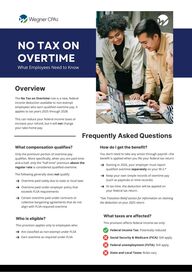
What is the No Tax on Overtime Provision?
The No Tax on Overtime provision allows eligible employees to deduct a portion of qualified overtime pay from their federal income tax for tax years 2025 through 2028, unless extended by Congress.
Key Information:
The provision applies only to non-exempt employees under the Fair Labor Standards Act (FLSA).
Only the premium portion of overtime pay qualifies. This means the “half” portion of “time-and-a-half.”
Payroll taxes like Social Security and Medicare still apply.
The benefit is realized when filing a tax return, not through payroll. Your paycheck will not change.
Who is Eligible?
This provision applies only to employees who:
- Are classified as non-exempt under FLSA
- Earn overtime as required under FSLA
- Use a valid Social Security number on their return
- Married filers only: Must file jointly to claim the deduction
The deduction is available for both itemizing and non-itemizing taxpayers.
What does "qualified overtime" mean?
Qualified overtime compensation (QOC) refers to the premium portion of overtime pay required under FSLA.
More specifically, when an employee is paid time-and-a-half, only the “half-time” premium above the regular rate is considered qualified overtime. For example, if your regular rate is $25 per hour, making your overtime rate $37.50 per hour, the $12.50 above your normal rate is considered qualified overtime.
The following does not qualify:
- Overtime paid solely due to state or local laws
- Overtime paid under employer policy that exceeds FLSA requirements
- Certain overtime paid under contracts or collective bargaining agreements that do not align with FLSA-required overtime
How the Deduction Works for Employees
No Tax on Tips Overtime Basics:
Deduction of up to $25,000 (MFJ)/$12,500 (Single) of qualified overtime income per year. The qualified overtime income must be properly reported.
Applies to federal income tax only (FICA still applies).
Income limits: $150,000 (single) / $300,000 (married filing jointly). Above these amounts, the deduction phases out.
Benefit is taken at tax filing.
Key Employee Responsibilities:
Track your overtime hours and premium pay.
Confirm with your employer: Is your premium reported separately on your W-2?
- For tax year 2025 only, your employer may not separately list qualified overtime on your W-2.
Keep paystubs and records. You may need them to support your deduction.
Inform your tax preparer that you have qualified overtime compensation.
Key Information for Employers & Business Owners
Employers must be able to identify and report qualified overtime premium pay separately from regular wages.
Accurate reporting depends on:
Proper employee classification
Payroll system configuration
Clear separation of base pay and overtime premium pay
Beginning in tax year 2026, employers will be required to separately report qualified overtime on Form W-2 (Box 12) and other informational returns.
2025 Transition Relief for Employers & Business Owners
Because Forms W-2 and 1099 will not include the new fields required under the One Big Beautiful Bill Act, the IRS is offering penalty relief in 2025.
Employers do not need to separately report qualified overtime on Forms W-2 or other informational returns this tax season.
However, employers are strongly encouraged to voluntarily provide this information to employees using one of the following methods:
- Form W-2, Box 14
- A supplemental statement
- Online portal
Employers may use a reasonable method to calculate the amount of qualified overtime for 2025.
What This Means for Employers in Practice
Although certain penalties are waived for 2025, this year should be used to:
Review non-exempt employee classifications under FLSA.
Confirm how overtime premium pay is tracked in your payroll system
Coordinate with payroll provider on W-2 reporting capabilities
Communicate proactively with employees about reporting expectations.
Prepare for separate overtime reporting beginning in tax year 2026.
Communicate high-level information to employees
Contact your Wegner CPAs tax advisor with questions or concerns.
Transition relief is temporary—full compliance will be expected once new forms are finalized.
FAQs: No Tax on Overtime
This provision provides a federal income tax benefit for employees, but it does not change other payroll tax obligations including:
- FICA
- FUTA
- State and Local Taxes (rules vary)
No. Withholding tables are not being adjusted for this deduction.
You may use a reasonable estimate of your qualified overtime based on available records, such as:
- Pay stubs or earning statements
- Employer-provided summaries or online portals
- A reasonable estimate of your overtime hours and pay if records are incomplete
If you worked for more than one employer in 2025, this can be done separately for each employer.
Time-consuming challenges will likely arise in the determination of QOC. These challenges may include separately identifying overtime hours paid for FLSA vs. other purposes, differing pay rates during the year or pay periods due to rate changes or doing prevailing wage jobs, and verifying that the correct regular rate of overtime was paid during the year. Since this deduction is allowed for all QOC during 2025, it may take time to go back to January 1, 2025 to calculate the proper amount of QOC to report for the year for each employee.
For the 2026 tax year, the IRS has already provided a draft W-2 which shows the QOC being reported in Box 12 with a code TT.
However, for the 2025 tax year, the IRS has stated that there will be no changes to the 2025 W-2 (i.e., no specific code). Barring any further guidance from the IRS, the most common recommendation is to use Box 14 – Other, along with a description such as “Qualified OT” or something similar.
These resources are designed for:
Employers with non-exempt employees
HR and payroll professionals
Business owners and managers
Employees who regularly earn overtime pay
Referral partners supporting employers or workers
Whether you’re responsible for payroll reporting or simply want to understand how this may affect your taxes, these guides provide clarity.
Employer Guide:
Which employees and overtime pay qualify
What changes (and what doesn’t) for payroll taxes
W-2 reporting requirements beginning in 2026
Transition guidance for tax year 2025
Practical action steps to prepare and stay compliant
Employee Guide:
Who may qualify for the deduction
What portion of overtime pay counts
What to expect on your W-2
How and when the tax benefit is applied
Simple steps to stay organized at tax time
Clear reporting and accurate documentation will be essential as the No Tax on Overtime deduction takes effect. These guides give employers and employees the straightforward guidance they need to prepare for 2025 and stay a step ahead of upcoming IRS changes.
Every workforce and every tax situation is different. If you have questions about how the No Tax on Overtime provision applies to you or your organization, reach out to the Wegner CPAs tax advisors for guidance.
Need help navigating the upcoming changes impacting the 2025 tax season? Download the 2025-2026 OBBBA Overview Guide and visit the No Tax on Tips resource page.