



No Tax on Tips: What Employers and Tipped Workers Need to Know

Tax Business Construction & Real Estate Cooperative Manufacturing OBBBA Outsourced Accounting
Cashier handing credit card back to customer after check out with prominent tip box featured
Published 12/10/2025

Understanding the No Tax on Tips Deduction:
Key Rules for Employers and Employees

Beginning in 2025, workers in tipped occupations may qualify for a new federal income tax deduction, up to $25,000 of reported tip income each year. For employers, this shift introduces new reporting expectations, a transition year of penalty relief, and preparation for updated IRS forms in 2026.

To help you prepare, Wegner CPAs’ tax advisors created two reference guides—one for employers and one for tipped employees—summarizing the rules, eligibility criteria, and 2025 transition guidance.

What You'll Get

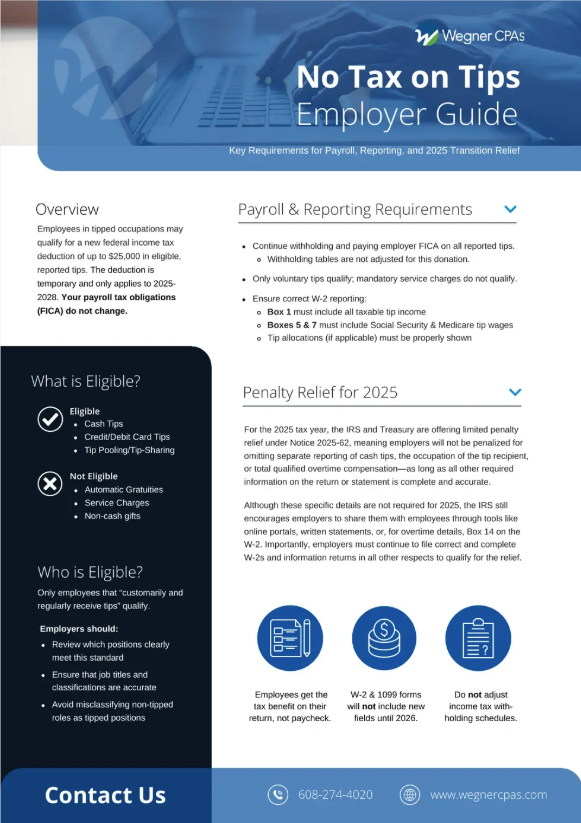
  • Employer Guide: Reporting responsibilities, recordkeeping, and 2025 transition rules.
  • Employee Guide: Eligibility, qualified tips, and simple recordkeeping expectations.

Access Our No Tax on Tips Guides

Guidance for Employers & Tipped Employees

Stay ahead of the 2025 tax season. Download our free No Tax on Tips resources covering essential rules, eligibility considerations, and 2025 transition guidance prepared by Wegner CPAs' tax advisors.
Why This Change Matters

The No Tax on Tips deduction offers a significant tax benefit, but only when tip reporting is accurate, voluntary tips are clearly distinguished from service charges, and W-2s reflect correct totals.

For employers, payroll tax obligations remain the same. However, stronger reporting systems, employee training, and early preparation for new IRS forms will be essential through the transition period.

Tip Eligibility

Eligible
  • Cash tips

  • Credit/debit card tips

  • Tip-sharing or pooling amounts

Not Eligible
  • Mandatory service charges

  • Automatic gratuities

  • Non-cash gifts

Key Distinction: Voluntary customer tips qualify. Service charges do not.

Employee Eligibility

To qualify for the deduction, an employee must:

    • Work in an occupation that “customarily and regularly receives tips” (e.g., servers, bartenders, baristas, stylists, hotel staff, delivery workers, valet attendants).

    • Receive voluntary tips.

    • Have those tips properly reported to their employer and included on Form W-2.

Important: Employees receive the tax benefit when filing their return, not through adjusted withholding.

How the Deduction works for Employees

No Tax on Tips Basics:
    • Deduction of up to $25,000 of qualified, properly reported tip income per year.

    • Applies to federal income tax only (FICA still applies).

    • Income limits: $150,000 (single) / $300,000 (married filing jointly).

    • Benefit is taken at tax filing.

Key Employee Responsibilities:
    • Report all tips accurately and on time.

    • Maintain simple backup records (daily totals, POS data, tip-outs).

    • Verify W-2 accuracy.

    • Inform their tax preparer that they received qualified tips.

Key Information for Employers & Business Owners

Employers must continue to:

    • Withhold and pay FICA taxes on all reported tips.

    • Capture voluntary tip income accurately.

    • Distinguish tips from service charges.

    • Maintain compliant recordkeeping and payroll processes.

    • Ensure W-2s reflect all tip wages accurately.

Only employees in legitimate tip-eligible roles qualify. Review job titles and classifications to avoid misclassification.

2025 Transition Relief for Employers & Business Owners

Because Forms W-2 and 1099 will not include the new fields required under the One Big Beautiful Bill Act, the IRS is offering penalty relief in 2025.

Employers do not need to separately report in 2025:

  • Cash tips
  • Employee occupation codes
  • Qualified overtime compensation

To qualify for this relief, employers must still file complete and accurate W-2s and information returns in all other respects.

What This Means for Employers in Practice

Although certain penalties are waived for 2025, this year should be used to:

  1. Evaluate and strengthen tip-reporting systems.

  2. Track cash tips separately, even if estimates are required.

  3. Capture occupation codes for tipped roles.

  4. Communicate proactively with employees about reporting expectations.

  5. Provide supplemental statements when helpful.

  6. Prepare payroll systems for 2026 IRS updates.

  7. Maintain documentation of estimation methods and tip-out structures.

Transition relief is temporary—full compliance will be expected once new forms are finalized.

FAQs: No Tax on Tips

Yes. Social Security and Medicare taxes still apply.


No. Withholding tables are not being adjusted for this deduction.


Employees can rely on Social Security tips (Box 7), Forms 4070 totals, employer disclosures (Box 14), and Form 4137 to calculate qualified tips.

If an employee has no reported tip income, they will be unable to claim this deduction.


No. Service charges are treated as wages, not tips. 

Not necessarily. The deduction applies to federal income tax only; state rules vary.

Contact your tax advisor for individual guidance. 

Support for your 2025 Transition

Clear reporting and accurate documentation will be essential as the No Tax on Tips deduction takes effect. These guides give employers and employees the straightforward guidance they need to prepare for 2025 and stay a step ahead of upcoming IRS changes.

If your organization needs help evaluating its tip-reporting processes, preparing for 2026 form updates, or understanding how these rules apply specifically to your workforce, reach out to the Wegner CPAs tax advisors for guidance. 

Access the Guide

Stay ahead of the 2025 tax season. Download our free No Tax on Tips resources covering essential rules, eligibility considerations, and 2025 transition guidance prepared by Wegner CPAs’ tax advisors.

Share

Related Insights
Tax Business Construction & Real Estate Cooperative Manufacturing OBBBA Outsourced Accounting
One Big Beautiful Bill Act (OBBBA) Overview Guide for 2025–2026
12/10/2025
Construction & Real Estate Business Tax
The Completed Contract Method for Construction Contractors
12/10/2025
Business Associations Construction & Real Estate Cooperative Financial News Manufacturing Non-Profit Outsourced Accounting Religious Tax
USPS Postmark Changes May Affect Year-End Tax Documents & Charitable Donations
12/08/2025

No Tax on Tips: What Employers and Tipped Workers Need to Know

Tax Business Construction & Real Estate Cooperative Manufacturing OBBBA Outsourced Accounting
Cashier handing credit card back to customer after check out with prominent tip box featured
Published 12/10/2025

Understanding the No Tax on Tips Deduction:
Key Rules for Employers and Employees

Beginning in 2025, workers in tipped occupations may qualify for a new federal income tax deduction, up to $25,000 of reported tip income each year. For employers, this shift introduces new reporting expectations, a transition year of penalty relief, and preparation for updated IRS forms in 2026.

To help you prepare, Wegner CPAs’ tax advisors created two reference guides—one for employers and one for tipped employees—summarizing the rules, eligibility criteria, and 2025 transition guidance.

What You'll Get

  • Employer Guide: Reporting responsibilities, recordkeeping, and 2025 transition rules.
  • Employee Guide: Eligibility, qualified tips, and simple recordkeeping expectations.

Access Our No Tax on Tips Guides

Guidance for Employers & Tipped Employees

Stay ahead of the 2025 tax season. Download our free No Tax on Tips resources covering essential rules, eligibility considerations, and 2025 transition guidance prepared by Wegner CPAs' tax advisors.

Why This Change Matters

The No Tax on Tips deduction offers a significant tax benefit, but only when tip reporting is accurate, voluntary tips are clearly distinguished from service charges, and W-2s reflect correct totals.

For employers, payroll tax obligations remain the same. However, stronger reporting systems, employee training, and early preparation for new IRS forms will be essential through the transition period.

Tip Eligibility

Eligible
  • Cash tips

  • Credit/debit card tips

  • Tip-sharing or pooling amounts

Not Eligible
  • Mandatory service charges

  • Automatic gratuities

  • Non-cash gifts

Key Distinction: Voluntary customer tips qualify. Service charges do not.

Employee Eligibility

To qualify for the deduction, an employee must:

    • Work in an occupation that “customarily and regularly receives tips” (e.g., servers, bartenders, baristas, stylists, hotel staff, delivery workers, valet attendants).

    • Receive voluntary tips.

    • Have those tips properly reported to their employer and included on Form W-2.

Important: Employees receive the tax benefit when filing their return, not through adjusted withholding.

How the Deduction works for Employees

No Tax on Tips Basics:
    • Deduction of up to $25,000 of qualified, properly reported tip income per year.

    • Applies to federal income tax only (FICA still applies).

    • Income limits: $150,000 (single) / $300,000 (married filing jointly).

    • Benefit is taken at tax filing.

Key Employee Responsibilities:
    • Report all tips accurately and on time.

    • Maintain simple backup records (daily totals, POS data, tip-outs).

    • Verify W-2 accuracy.

    • Inform their tax preparer that they received qualified tips.

Key Information for Employers & Business Owners

Employers must continue to:

    • Withhold and pay FICA taxes on all reported tips.

    • Capture voluntary tip income accurately.

    • Distinguish tips from service charges.

    • Maintain compliant recordkeeping and payroll processes.

    • Ensure W-2s reflect all tip wages accurately.

Only employees in legitimate tip-eligible roles qualify. Review job titles and classifications to avoid misclassification.

2025 Transition Relief for Employers & Business Owners

Because Forms W-2 and 1099 will not include the new fields required under the One Big Beautiful Bill Act, the IRS is offering penalty relief in 2025.

Employers do not need to separately report in 2025:

  • Cash tips
  • Employee occupation codes
  • Qualified overtime compensation

To qualify for this relief, employers must still file complete and accurate W-2s and information returns in all other respects.

What This Means for Employers in Practice

Although certain penalties are waived for 2025, this year should be used to:

  1. Evaluate and strengthen tip-reporting systems.

  2. Track cash tips separately, even if estimates are required.

  3. Capture occupation codes for tipped roles.

  4. Communicate proactively with employees about reporting expectations.

  5. Provide supplemental statements when helpful.

  6. Prepare payroll systems for 2026 IRS updates.

  7. Maintain documentation of estimation methods and tip-out structures.

Transition relief is temporary—full compliance will be expected once new forms are finalized.

FAQs: No Tax on Tips

Yes. Social Security and Medicare taxes still apply.


No. Withholding tables are not being adjusted for this deduction.


Employees can rely on Social Security tips (Box 7), Forms 4070 totals, employer disclosures (Box 14), and Form 4137 to calculate qualified tips.

If an employee has no reported tip income, they will be unable to claim this deduction.


No. Service charges are treated as wages, not tips. 

Not necessarily. The deduction applies to federal income tax only; state rules vary.

Contact your tax advisor for individual guidance. 

Support for your 2025 Transition

Clear reporting and accurate documentation will be essential as the No Tax on Tips deduction takes effect. These guides give employers and employees the straightforward guidance they need to prepare for 2025 and stay a step ahead of upcoming IRS changes.

If your organization needs help evaluating its tip-reporting processes, preparing for 2026 form updates, or understanding how these rules apply specifically to your workforce, reach out to the Wegner CPAs tax advisors for guidance. 

Stay Connected

Join our email list to receive our most recent blog posts, notification of upcoming seminars, and access to new resources!

Share

Related Insights
Tax Business Construction & Real Estate Cooperative Manufacturing OBBBA Outsourced Accounting
One Big Beautiful Bill Act (OBBBA) Overview Guide for 2025–2026
12/10/2025
Construction & Real Estate Business Tax
The Completed Contract Method for Construction Contractors
12/10/2025
Business Associations Construction & Real Estate Cooperative Financial News Manufacturing Non-Profit Outsourced Accounting Religious Tax
USPS Postmark Changes May Affect Year-End Tax Documents & Charitable Donations
12/08/2025